Purpose
Background: ITGA3-associated ILNEB syndrome is a rare multisystem disorder involving lung, kidney, and skin pathology, with limited therapeutic options and few reported long-term survivors.
Methods: We applied the Predictable Medicine™ pipeline and BioNAV™ platform to patient-derived transcriptomic data from a young adult male with compound heterozygous ITGA3 variants and progressive lung fibrosis. Three RNA-seq-derived datasets were processed into BioNAV™-compatible gene-expression inputs and analyzed independently to generate patient-specific drug-prediction outputs: a PacBio HiFi/Revio Iso-Seq hair-follicle dataset, a Complete Genomics synthetic long-read bulk RNA-seq hair-follicle dataset, and a 10x Chromium 3′ single-cell RNA-seq PBMC dataset. Cross-dataset consistency was assessed using Pearson correlations of shared compound percentile ranks.
Results: Despite distinct tissue sources and sequencing platforms, the three BioNAV™ drug-prediction outputs showed mixed cross-modality relationships, with a Pearson correlation of r = 0.44 between the two long read hair samples, but negative correlations between the PBMC and the two hair samples (r = -0.28 and –0.45). BioNAV™ outputs for prior applied treatments (mycophenolic acid, pirfenidone, tacrolimus) showed mixed or uncertain support, consistent with observed clinical outcomes, yet multiple candidate molecules ranked highly across all datasets, including Zileuton, Montelukast, Ifenprodil, Ciprofibrate, Amitriptyline, Prednisolone. Furthermore, pathway-level analyses suggested that high-ranking drug candidates converged on patient-specific network biology, including AKT/PI3K signaling, NGF/BDNF-related neurotrophin signaling, and PPARα signaling.
Conclusions: These findings nominate candidate therapies and support pathways for experimental follow-up. The study demonstrated the ability to utilize transcriptomic network analysis to generate actionable, mechanistically grounded therapeutic candidates from limited, real-world biological data, even across distinct tissue modalities.
Introduction
Integrin α3β1, encoded by ITGA3 on chromosome 17q21.33, is a heterodimeric transmembrane receptor critical for epithelial cell adhesion to basement membrane laminins in the lung, kidney, and skin1. Biallelic loss-of-function variants in ITGA3 cause a severe autosomal recessive multiorgan disorder classically defined by the triad of interstitial lung disease (ILD), nephrotic syndrome (NS), and junctional epidermolysis bullosa (JEB) that collectively constitutes ILNEB syndrome2. Since its initial molecular characterization, fewer than 25 patients have been reported in the literature1, 3. ILNEB is currently one of the rarest and most lethal genodermatoses, with a neonatal mortality exceeding 95% by age two years in classic-onset cases1.
The molecular architecture of ILNEB follows strict genotype-phenotype manifestation4. The most severe multiorgan phenotype is related to null alleles that drive complete α3 protein loss, while hypomorphic missense alleles may yield attenuated presentations with phenotypic heterogeneity, including skin fragility without overt pulmonary or renal structural defects4. Compound heterozygous genotypes combine a loss-of-function allele with a damaging missense that predicts intermediate or asymmetric phenotypes. Their expanding recognition has broadened the recognized clinical spectrum of ITGA3-related disease5–6. Crucially, intronic splice-disrupting variants in ITGA3 can also produce disease through aberrant splicing, which enhances the molecular complexity and requires careful characterization of the variants2.
Unravel Biosciences leverages patient-derived RNA profiles to build a molecular representation of disease state using BioNAV™, its causal AI network platform. Through our Predictable Medicine™ pipeline, patient-specific transcriptomic data are mapped onto a therapeutic response network of 40,000 existing compounds predicted to shift the patient’s network toward a heathy state. This library of compounds includes close to 3,000 approved drugs, enabling the prediction of drug that can be rapidly repurposed within the timeframe of the very same patient. This network-driven approach enables mechanistic hypothesis generation and drug prioritization from a single patient’s transcriptomic data.
We have previously applied BioNAV™ to predict interventions for Rett syndrome, a rare devastating disorder affecting both the body and cognition. The top repurposed hit, vorinostat, showed strong efficacy in a severe mouse model7. Unravel has since initiated a Rett syndrome trial using RVL001, a proprietary oral liquid formulation of vorinostat8, while developing RVL002, a novel therapeutic candidate. In May 2024, Unravel received Orphan Drug Designation, showcasing the translational capability of the platform.
In this paper, we report a patient with compound heterozygous ITGA3 variants, including a canonical splice-donor variant and a missense variant, predicted to result in a marked reduction of functional α3β1 integrin, consistent with the ILNEB disease spectrum5, 9. We applied our pipeline to this patient transcriptomic datasets to identify candidate therapeutic mechanisms and prioritize drugs for potential repurposing, including Zileuton, Montelukast, Ifenprodil, Ciprofibrate, Amitriptyline, Prednisolone, which converge on the patient-specific fibrotic and inflammatory network biology.
Clinical Presentation
The patient is a young adult male presenting with a rare multi-system fibrotic disorder. In childhood, the patient developed a mild shin rash that resolved spontaneously, with non-specific biopsy findings. He also had dental enamel hypoplasia, a feature shared with his father, a heterozygous carrier. Progressive renal fibrosis with unilateral renal atrophy required a living-donor kidney transplant. Explant histology revealed end-stage fibrosis without an identifiable cause. The cumulative multi-organ findings of skin, renal and pulmonary involvement prompted genetic evaluation. Whole exome sequencing identified compound heterozygous pathogenic ITGA3 variants. A canonical splice-donor variant, NM_002204.4: c.2070+1G>A (intron 15), was classified as Pathogenic (PVS1, PM2, PP5); splice prediction tools (MaxEnt, NNSPLICE, SSF, GeneSplicer) confirmed complete abolition of the donor site, predicting frameshift, premature termination, and nonsense-mediated decay of the affected allele2. A missense variant, c.1973C>G; p.(Thr658Arg) (exon 15), located within the integrin α-domain superfamily, was classified as Likely Pathogenic (PM1, PM2, PP3, PP5), with multiple in silico tools converging on a deleterious prediction (CADD 25.6, SIFT deleterious, PolyPhen-2 probably damaging, MutationTaster deleterious). Together, this null-plus-hypomorphic genotype is predicted to result in a marked reduction of functional α3β1 integrin. His clinical phenotype is consistent with ILNEB syndrome previously described in biallelic ITGA3 loss-of-function cases1, 3, 9.
Pulmonary disease first declared itself in early adulthood after a prolonged respiratory illness, with spirometry showing reduced lung function and CT imaging revealing airway abnormalities of unclear chronology. The patient later developed bilateral spontaneous pneumothoraces (right lung, then left in 2022), each requiring surgical bleb resection and pleurodesis. Lung biopsies obtained at both procedures revealed an evolution from early airway inflammation (2017) to severe small airway fibrosis consistent with bronchiolitis obliterans syndrome (BOS) by 2022, a pattern histologically distinct from the predominantly alveolar fibrosis reported in prior ITGA3 cases3, 9.
Beyond the lung and kidney, the patient exhibits esophageal dysmotility, chronic nausea, diarrhea, and low body weight, suggesting gastrointestinal epithelial dysfunction, as well as significant osteopenia. His clinical course is characterized by episodic inflammatory flares with incomplete recovery, which raised concern for an underlying immune dysregulatory component. Supporting this, flow cytometry showed a complete absence of surface ITGA3 on peripheral blood immune cells, including T cells, B cells, NK cells, and Tregs, contrasting with the 30-40% surface expression observed in healthy controls. This previously unreported finding has potential implications for immune homeostasis.
The patient is maintained on mycophenolate mofetil and tacrolimus for renal transplant immunosuppression. He was unable to tolerate RTK inhibitor anti-fibrotic therapy (nintedanib/pirfenidone class) due to GI side effects, and is currently receiving nerandomilast (Jascade), a recently approved anti-fibrotic agent. Initiation of axatilimab or belumosudil, which target monocyte/macrophage-driven airway fibrosis in BOS, is planned given the histopathological similarity to Graft-versus-host disease (GVHD) associated BOS, although the primary driver in this patient is thought to be ongoing epithelial sloughing rather than alloimmune inflammation.
Methods
Patient-derived transcriptomic datasets
Patient-derived RNA-seq datasets were provided by Research to the People (RTTP) as part of their ITGA3 Rare Disease Lung Fibrosis Hackathon. The datasets were first evaluated for compatibility with the Predictable Medicine™ pipeline. Three RNA-seq-derived datasets were carried forward for BioNAV™ analysis: a PacBio HiFi/Revio Iso-Seq hair-follicle (Hair_PacBio) dataset, a Complete Genomics synthetic long-read bulk RNA-seq hair-follicle (Hair_CG) dataset, and a 10x Chromium 3′ single-cell RNA-seq PBMC (PBMC) dataset. These datasets were analyzed independently to compare BioNAV™ predictions across sequencing workflows and tissue contexts. Each accepted dataset included one "ILNEB Affected" sample and one "Unaffected Control" sample according to the provided metadata (Supplementary File 1). The available metadata did not indicate whether the comparator sample was family-matched, age/sex-matched, or otherwise clinically matched.
BioNAV™ compatibility review focused on whether each dataset could be represented as a gene-expression matrix suitable for expression-based analysis. This requirement is consistent with standard RNA-seq read-summarization and count-based differential-expression workflows, which operate on reads or counts assigned to genes or other genomic features10–11. The PacBio Iso-Seq dataset included isoform-level abundance and FLNC read-count outputs that were aggregated to gene-level abundance estimates. The Hair_CG dataset was processed into a gene-level count matrix from aligned transcript outputs. The PBMC dataset provided Cell Ranger gene-by-cell count matrices that were aggregated into pseudo-bulk gene-expression inputs. All three resulting gene expression matrices were used as BioNAV™ inputs.
The PacBio and Complete Genomics hair-follicle datasets each contained one affected and one unaffected bulk RNA-seq sample, with no biological replicates. While the PBMC single-cell dataset was also derived from one affected and one unaffected sample, computational pseudo-bulk profiles were generated from cell-level data for downstream analysis, consistent with pseudo-bulk strategies used to aggregate single-cell counts for sample-level analysis12. However, these pseudo-bulk profiles should not be interpreted as independent biological replicates.
BioNAV™ analysis
Each accepted transcriptomic dataset was processed through Unravel Biosciences' Predictable Medicine™ pipeline, which builds on an AI-enabled drug prediction and gene-network analysis approach for target-agnostic therapeutic discovery7. In this workflow, each affected RNA-seq profile is compared against its corresponding unaffected control sample to generate a patient-specific molecular-state representation. This representation is then mapped onto a pre-trained heterogeneous interaction network encoding curated relationships among drugs, genes, and transcription factors (TFs) derived from integrated multi-source data. The resulting personalized differential expression network is then scored against a library of approximately 40,000 compounds to identify candidate compounds predicted to shift the patient's molecular state toward a healthier reference state through network-level mechanisms. Outputs are reported as percentile ranks relative to all scored compounds within each dataset, with higher percentile ranks indicating stronger predicted therapeutic direction. BioNAV™ also provides mechanistic pathway-level explanations of each candidate's predicted effects, enabling prioritization of molecules based on shared network biology rather than canonical drug targets alone7.
For the Hair_PacBio dataset, transcript-level outputs were collapsed to gene-level abundance by summing full-length non-chimeric (FLNC) read counts across transcripts assigned to the same annotated gene13. Novel or unannotated gene entries were excluded from the Hair_PacBio gene-level matrix before downstream normalization. For the Hair_CG dataset, gene-level counts were loaded from the aligned Complete Genomics output, retaining the affected and unaffected-control sample columns. Gene identifiers were version-stripped before downstream processing, and the resulting gene-level matrix was used to generate BioNAV™ omics and annotation input files. The PBMC single-cell dataset was generated using 10x Genomics single-cell RNAseq and processed with Cell Ranger to produce filtered gene-by-cell count matrices13–14 (Supplementary File 1). The affected and unaffected-control matrices were concatenated, normalized to 10,000 counts per cell, log-transformed, and used to identify 2,000 highly variable genes. Principal component analysis was performed on the highly variable genes, and a nearest-neighbor graph was constructed using 30 principal components in Scanpy15. Cells were then clustered using the Leiden algorithm at resolution 0.0516. Raw UMI counts, retained separately before normalization, were summed within Leiden cluster-stratified groups to generate pseudo-bulk count profiles12. All three qualifying datasets underwent DESeq2 size-factor normalization before BioNAV™ analysis11.
For the Hair_PacBio and Hair_CG datasets, synthetic replicate omics profiles were generated by applying randomized noise perturbation to each sample independently. Each replicate was created by multiplying normalized omics values by independent log-normal noise factors (σ = 0.05). Seven synthetic replicates were generated per sample, with the original samples retained in the final dataset. The synthetic replicates were used for computational input generation and should not be interpreted as independent biological replicates.
Candidate molecules were reported as percentile ranks within each analyzed dataset. Percentile ranks are relative to all predicted molecules for that dataset, with higher percentile ranks indicating a stronger predicted therapeutic direction relative to other scored molecules in the same analysis. However, these percentile ranks should not be interpreted as absolute effect sizes.
Cross-modality comparison and candidate selection
BioNAV™ drug prediction outputs derived from the three datasets were compared to assess whether predicted candidate-molecule signals were consistent across sequencing platforms and biologically distinct sample contexts. The cross-modality drug-prediction comparison was conducted using Pearson correlation (r) of each drug's percentile rank across datasets. To identify the top drugs across the datasets, candidates were ranked using a composite selection score (CSS), defined as 𝐶𝑆𝑆 = 100 − 𝑀𝑃𝑅 + 𝑆𝐷, where MPR is the mean percentile rank across the datasets and SD is the standard deviation of percentile ranks across the datasets, such that lower CSS values indicate stronger and more consistent predicted therapeutic direction across datasets.
Candidates were first sorted by this score, and then from the full ranked list, a subset of molecules were manually downselected based on their potential suitability for clinical translation. Candidates were prioritized if they were FDA-approved or had established clinical safety profiles and meaningful prior human exposure data, making them more readily actionable for future therapeutic evaluation. The full ranking is provided in Supplementary File 2.
Drug Cluster pathway analysis
Candidate-level interpretation focused on shared patient-specific network biology rather than on single primary drug targets alone. Pathway and cluster outputs were reviewed to identify recurring biological themes among highly ranked molecules, which were then used to nominate mechanistic hypotheses and experimental validation readouts.
For drugs predicted above the 85th percentile (N drugs), we retrieved the sample-specific BioNAV™ subnetwork generated from the patient's seed genes (i.e. the top K differentially expressed genes derived from the patient relative to the control) and our pretrained drug‑gene‑TF graph. Drugs with fewer than 2 nodes in the subnetwork were subsequently excluded from downstream analysis. We then computed the Jaccard Index (JI) between the node sets of each drug pair and converted it to a Jaccard distance (JD = 1‑JI) for clustering.
Spectral clustering (numpy v2.4.1, scipy v1.17.0) was applied iteratively to the JD matrix using six predefined cluster counts, set at 10%, 15%, 20%, 25%, 30% and 35% of N. A consensus co‑clustering distance matrix was then built, where for each drug pair the number of times the two drugs appeared in different clusters was counted, such that CD(p,q) = 0 indicates drug pair p and q was always in the same cluster, while CD(p,q) = 6 indicates they were never co-clustering. Agglomerative hierarchical clustering was applied to this consensus distance matrix, with the number of clusters selected to maximize the gene‑Jaccard silhouette score17.
Drugs assigned to a cluster but having a silhouette score below that cluster’s average were reassigned to a separate pseudo-cluster comprising the drug and its nearest neighbors. To define this neighborhood, we first computed an adaptive boundary (AB), defined as the average JD-space distance between each drug and its 5 closest neighbors, averaged across all drugs. Drugs with at least one neighbor closer than the AB were classified as “loosely clustered”, while drugs with no neighbor within its boundary were classified as “isolated” and analyzed individually.
For each cluster, pseudo-cluster and isolated drug, we took the intersection of network nodes and ran an over-representation pathway enrichment test using GSEApy (v1.1.11), querying the Reactome Knowledgebase, KEGG database, and Gene Ontology Biological Processes annotations18–20.
Results
Accepted datasets and cross-tissue concordance
To identify repurposable candidate treatments for this ITGA3-related ILNEB patient, we applied the BioNAV™ drug-prediction pipeline to three RNA-seq datasets derived from hair-follicles (one dataset from PacBio HiFi/Revio Iso-Seq long-read; one dataset from Complete Genomics synthetic assembly long-read), and PBMC (one dataset from 10x Genomics Chromium 3′ single-cell), sampled from the patients and unmatched healthy control, provided by RTTP. We first evaluated the consistency of predictions across these three datasets and two tissue types.
Because the datasets arose from different biological sources and sequencing workflows, raw transcriptomic similarity was not expected. Despite this, BioNAV™ drug-prediction outputs showed a positive within modality relationship for the long-read hair follicles (r = 0.44), However, cross-modality correlation were negative between the PBMC and the hair follicles (r = -0.28 with PacBio; r = -0.45 with CG). Three factors may explain the lack of concordance. The tissue types differ substantially in cellular composition and diversity, with the PBMC representing a more monogenic non-adhesive surrogate. The PBMC 10X genomics is comprised of aggregate single cell data, which were provided as pseudo-bulk counts. In our selection, hair follicles were favored over PBMC as the surrogate RNA source more reflective of ITGA3-expressing cell types directly affected in ILNEB, whereas PBMCs show more restricted ITGA3 expression limited largely to a hematopoietic stem cell subset. As such, our strategy will emphasize selection of repurposable drugs ranked in the top 85th percentile based on the two hair follicles datasets, and above 35th percentile for the PBMC dataset, although a top candidate would be higher. We consider the bottom 25th percentile to be toxic.
Comparison with patient-relevant prior therapies
As described in the Clinical Presentation, this patient has been treated with mycophenolate mofetil and tacrolimus for renal transplant immunosuppression, was unable to tolerate nintedanib/pirfenidone anti-fibrotic therapy and is now receiving nerandomilast, which has also been considered as a newer anti-fibrotic option in this disease class. We therefore reviewed BioNAV™ outputs for these clinically relevant compounds to assess whether model predictions were consistent with this treatment history. We interpreted each drug as unlikely to be therapeutic, mixed, uncertain, or therapeutic. “Unlikely” denotes insufficient overall support for prioritization based on the cross-dataset pattern, “Mixed” denotes weak or inconsistent percentile rankings across datasets, “Uncertain” indicates that the compound was not predicted for that dataset, and “Therapeutic” denotes consistent strong support for that compound across datasets (Table 1). Mycophenolic acid, pirfenidone, and tacrolimus showed variable percentile ranks, consistent with observed poor or mixed clinical outcomes. Nintedanib ranked highly in the hair follicle analysis but was not predicted for the PBMC dataset, therefore it was treated as uncertain rather than as a robust cross-modality prediction. Nerandomilast was not predicted for either dataset in this run because it was not present in the BioNAV™ compound database. Therefore, the absence of a percentile rank reflects lack of database coverage rather than an unfavorable prediction. Piclamilast, the closest represented PDE4B inhibitor in the database, ranked highly in both hair modalities and was therefore treated as a PDE4B-related follow-up hypothesis, not as a direct substitute or clinical recommendation.
| Drug | PBMC | Hair_PacBio | Hair_CG | Model interpretation |
|---|---|---|---|---|
| Mycophenolic acid | 86.3 | 51.9 | 47.8 | Unlikely |
| Pirfenidone | 69.4 | 49.2 | 75.3 | Unlikely |
| Tacrolimus | 96.4 | 42.0 | 92.8 | Therapeutic |
| Nintedanib | n/d | 99.1 | n/d | Uncertain |
| Nerandomilast | n/d | n/d | n/d | Uncertain |
| Piclamilast (closest PDE4B inhibitor) | 36.4 | 96.9 | 88.8 | Therapeutic |
Table 1. BioNAV™ model outputs for therapies relevant to the patient treatment context. Percentile ranks are shown for the hair-follicle and PBMC RNA-seq-derived analyses. Model interpretations summarize the level of predicted therapeutic cross-modality support for each compound as either unlikely to be therapeutic, uncertain, or therapeutic, while n/d denotes not detected or predicted.
Top cross-supported candidate molecules
The main drug-repurposing analysis identified multiple cross-supported molecules with high percentile ranks across both hair follicles and PBMC datasets. Table 2 lists selected high-ranking candidates prioritized for pathway interpretation (the full BioNAV™ and pathway export tables for all datasets are provided in Supplementary File 2). These candidates were first ranked using a Composite Selection Score (CSS) and then manually downselected for prior clinical safety data or FDA-approval status to prioritize translational feasibility, consistent with the selection criteria described in the Methods. These candidates represent research-use predictions to prioritize experimental follow-up and should not be interpreted as clinical treatment recommendations.
| Drug | PBMC | Hair_PacBio | Hair_CG | Model interpretation |
|---|---|---|---|---|
| zileuton | 49.5 | 99.0 | 99.1 | Therapeutic |
| dihydrexidine | n/d | 96.4 | 97.4 | Therapeutic |
| aceclofenac | n/d | 95.6 | 98.7 | Therapeutic |
| gabexate | n/d | 95.0 | 95.8 | Therapeutic |
| riluzole | 65.2 | 94.0 | 94.3 | Therapeutic |
| granisetron | n/d | 94.8 | 92.1 | Therapeutic |
| ciprofibrate | 69.3 | 97.5 | 89.4 | Therapeutic |
| nicardipine | 39.9 | 87.5 | 98.0 | Therapeutic |
| ethambutol | 61.5 | 84.5 | 97.7 | Therapeutic |
| ifenprodil | n/d | 90.2 | 80.4 | Therapeutic |
| entinostat | 64.5 | 79.3 | 97.7 | Therapeutic |
| montelukast | 59.5 | 76.8 | 91.4 | Therapeutic |
| amitriptyline | 49.4 | 68.5 | 85.9 | Therapeutic |
| mocetinostat | 48.6 | 68.3 | 96.6 | Therapeutic |
| pimecrolimus | 39.5 | 61.5 | 98.0 | Therapeutic |
| teriflunomide | 66.1 | 47.1 | 93.9 | Therapeutic |
| prednisolone | 99.5 | 99.6 | 48.0 | Therapeutic |
| tacrolimus | 96.0 | 42.0 | 92.8 | Therapeutic |
| nintedanib | n/d | 99.1 | n/d | Therapeutic |
Table 2. Top cross-supported candidate molecules identified by BioNAV™ analysis. Candidate molecules are shown with percentile rank for each hair-follicles and PBMC dataset. Higher percentile ranks indicate stronger predicted therapeutic direction relative to other scored molecules within each dataset, ranging from 0 to 100. Those that were not predicted in a dataset are predicted to not affect the molecular network in either direction, therefore are considered neither good or bad.
Shared pathway and network biology
Drug- and pathway-level review indicated that the candidate list was not simply a collection of unrelated high-ranking drugs. Several molecules with different known primary targets appeared to converge on shared patient-specific network programs. This network-level interpretation is important because single canonical drug targets can be misleading when the predicted effect depends on downstream pathway context.
Of the 171 drugs predicted above the 85th percentile in either dataset, consensus clustering identified 71 clusters, plus 33 loosely clustered and 17 isolated candidates. Pathway enrichment based on GSEApy, Reactome, KEGG, or GO, on each cluster's shared network nodes is summarized below (full cluster reports for PBMC and the hair follicles are provided in Supplementary Files 3, 4 and 5 respectively).
An example of such convergence is the co-occurrence of compounds with opposite annotations, such as the dopamine receptor agonist dihydrexidine (97 percentile) and antagonist sulpiride (98%) (Supplementary File 2) among highly ranked candidates in the hair follicles samples, yet both were predicted to interact with overlapping downstream network biology in this patient, including estrogen-related and interleukin-related programs, along with other remodeling and stress-response pathways. This result supports interpreting the candidate list at the level of patient-specific network convergence rather than primary receptor labels alone.
Three broader pathway themes emerged from the pathway-level review. First, AKT/PI3K signaling appeared consistently across drug clusters. AKT1/AKT2/AKT3 genes were upregulated in both hair-follicle datasets (Table 3), supporting AKT/PI3K as a plausible fibrosis-relevant module. PBMC showed a discordant pattern, with AKT1 and AKT3 downregulated and AKT2 unchanged. Second, NGF/BDNF and related neurotrophin signaling were downregulated in both hair-follicle datasets, while PBMC showed no significant change in either gene (Table 3).
Although these pathways are more commonly discussed in neurological contexts, in this analysis they likely reflect inflammatory, stress-response, survival and tissue-repair biology. Zileuton and Prednisolone were identified as candidates predicted to increase NGF/BDNF-related signaling. Third, PPARα signaling was notable, particularly because Ciprofibrate, a known PPARα agonist, ranked highly across both datasets, while Ifenprodil and Amitriptyline converged on NGF and PPARα as well (Figure 1).
Interestingly, the two green tea catechins epigallocatechin and epicatechin gallate rank among the top-scoring natural compounds in the fibrosis screen, with epigallocatechin in the 94th percentile for PBMC and 99.8th percentile for Hair Follicle PacBio, and epicatechin gallate in the 41st percentile for PBMC but 96.2nd and 84.7th percentiles in the two hair follicle assays, highlighting a consistent, tissue-level signal for this safe, food-derived class of molecules (Supplementary File 2). Considering their low oral bioavailability, short half-life and rapid metabolism, these would unlikely be considered as primary line of treatment and would be more suitable as adjunct nutraceutical support.
| Gene | Tissue | p-value | log2FC |
|---|---|---|---|
| AKT1 | Hair_CG | 2.269e-04 | 0.122 |
| AKT2 | Hair_CG | 3.806e-09 | 0.642 |
| AKT3 | Hair_CG | 6.971e-16 | 0.970 |
| AKT1 | Hair_PacBio | 7.328e-05 | 0.225 |
| AKT2 | Hair_PacBio | 1.262e-07 | 0.442 |
| AKT3 | Hair_PacBio | not detected | not detected |
| AKT1 | PBMC | 0.037 | -0.256 |
| AKT2 | PBMC | 0.207 | 0.066 |
| AKT3 | PBMC | 0.036 | -0.309 |
| BDNF | Hair_CG | 7.962e-12 | -1.803 |
| NGF | Hair_CG | 7.525e-10 | -1.508 |
| BDNF | Hair_PacBio | 4.769e-11 | -0.657 |
| NGF | Hair_PacBio | 2.054e-10 | -1.070 |
| BDNF | PBMC | 0.433 | 1.397 |
| NGF | PBMC | 0.477 | 0.898 |
Table 3. Differential expression of AKT/PI3K and NGF/BDNF pathway genes in hair-follicle and PBMC samples (affected vs. unaffected control).
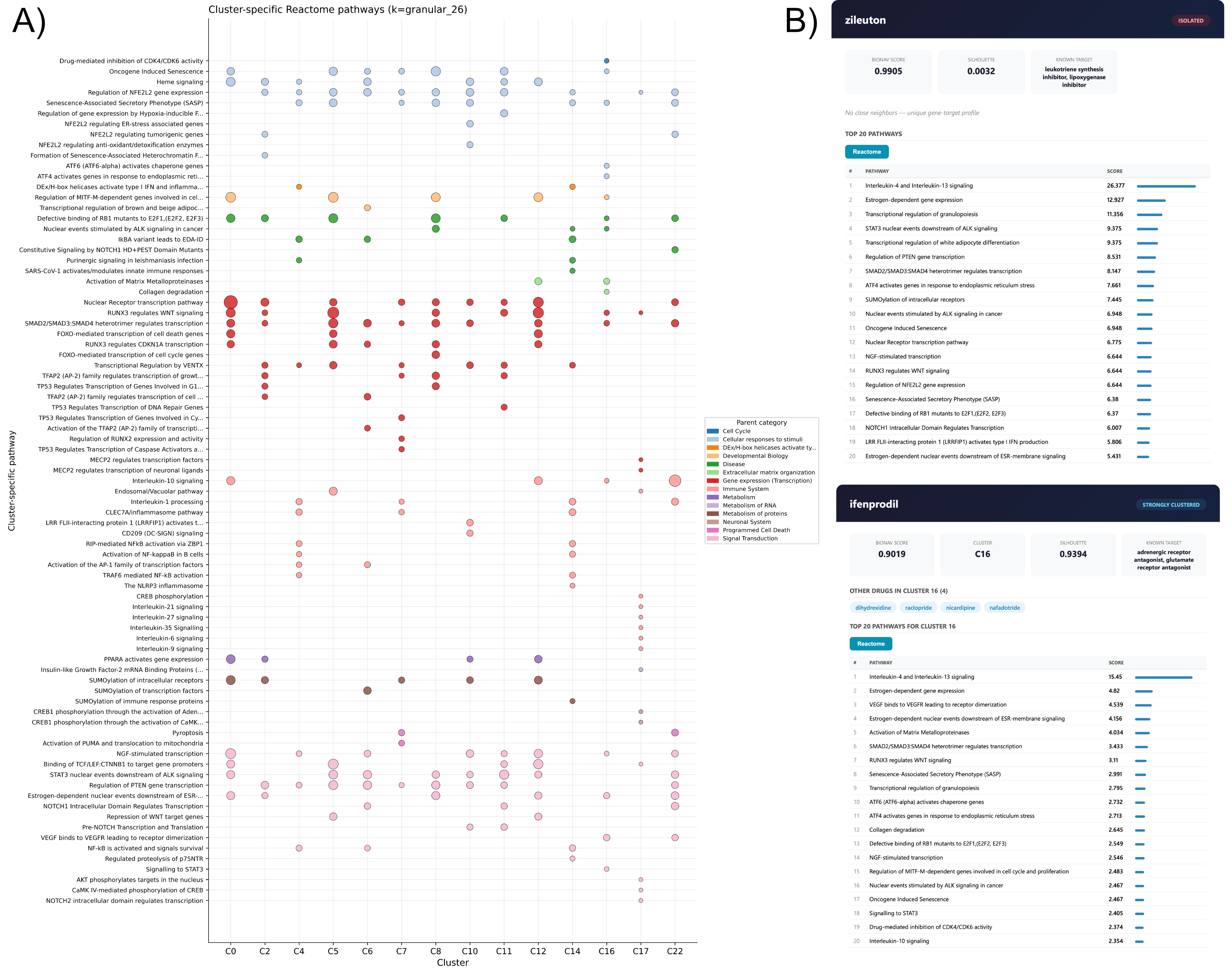
Figure 1. Pathway cluster analysis of the hair follicle BioNAV results. (Left) Bubble plot showing highly ranked drugs grouped into clusters based on patient-specific subnetwork of each drug. Columns represent drug clusters, row represent Reactome pathways significantly enriched within each cluster. Bubble size is proportional to the negative logarithm of the FDR adjusted p-value, with larger bubbles indicating stronger statistical enrichment. Bubbles are colored based on the parent term, for instance all immune-related pathways are shown in light red. (Right) Cluster-level details for Zileuton and Ifenprodil, two of our top candidates, show the pathways significantly enriched within each drug’s BioNAV subgraph, sorted by significance.
Taken together, the BioNAV™ analysis generated both candidate-drug and pathway-level outputs to prioritize. The candidate-drug output nominates individual molecules for research screening, while the pathway-level output nominates associated biology as mechanistic hypotheses. A future next step would prioritize screening selected top candidates in relevant in vitro fibrosis models to evaluate fibrosis markers, pathway activity and transcriptomic rescue.
Discussion
This study applies BioNAV™ to patient-derived RNA-seq data from an ITGA3-associated ILNEB lung fibrosis case to generate drug-repurposing and pathway hypotheses.
BioNAV™ drug-prediction outputs, rather than raw transcriptomic profiles, revealed a positive within-modality correlation between the two hair-follicle datasets (r = 0.44), but negative cross-modality correlations when hair-follicle predictions were compared against the PBMC dataset (r = -0.28 with PacBio; r = -0.45 with Complete Genomics). Concordance was tissue- and platform-dependent, being strongest within a matched long-read hair-follicle context and weaker across substantially different tissue and sequencing modalities. Nonetheless, BioNAV™ predictions tracked context-dependent network biology rather than simply propagating shared technical or platform-level artifacts, as seen by the relevant drug and associated pathways.
As a face-validity check, BioNAV™ outputs were compared against the patient's actual treatment history. Mycophenolic acid, pirfenidone, and tacrolimus showed variable, dataset-inconsistent percentile ranks, mirroring this patient's mixed real-world clinical response to these agents, while nintedanib ranked highly only in the hair-follicle dataset and was accordingly treated as an uncertain rather than robust cross-modality prediction. This concordance between model output and observed clinical response, even though anecdotal in a single patient, adds a layer of interpretive confidence to the novel candidates nominated below.
We observed the co-occurrence of dihydrexidine and sulpiride, which are dopamine receptor agonist and antagonist, respectively, which instead are predicted to act on downstream estrogen- and interleukin-related network biology in this patient, reinforcing that predictions should be read as convergence of networks rather than single-target pharmacology.
In particular, AKT/PI3K, NGF/BDNF-neurotrophin, and PPARα-associated signaling emerged as pathway hypotheses relevant to fibrosis, inflammatory remodeling, stress response, and tissue repair. This is supported at the gene-expression level by the upregulation of AKT1, AKT2 and AKT3 and downregulation of BDNF/NGF in both hair-follicle datasets. PBMC showed a discordant expression pattern for these specific genes (AKT1 and AKT3 downregulated, AKT2, BDNF and NGF unchanged), even though BioNAV pathway-level predictions still converged on AKT/PI3K and NGF/BDNF network biology in PBMC.
The PPARα signal is directly supported by ciprofibrate, a known PPARα agonist, although it may additionally reflect broader convergence of additional candidates on PPARα-associated biology through off-target or downstream network effects. The PBMC-derived signal is particularly notable given this patient's previously unreported finding of complete absence of surface ITGA3 on peripheral T cells, B cells, NK cells and Tregs, compared with 30-40% expression in unaffected samples. This immune-dysregulation provides a biological connection between the RNA network approach and the inflammatory and stress-response pathways identified, suggesting the predictions reflect genuine biological contributions to the disease rather than a surrogate tissue effect.
Zileuton and Montelukast are leukotriene-pathway anti-inflammatories, which could not only dampen the airway inflammatory component but have further antifibrotic activities based on the targeted pathway21. Ifenprodil, an NMDA receptor antagonist, reduced fibrosis by 56% in an IPF animal model and met its primary endpoint in a phase 2 human trial and has FDA orphan drug designation for IPF22. Ciprofibrate is a PPARα agonist approved for treating hyperlipidemias through enhanced fatty acid oxidation and lipoprotein lipase activity23. PPARα activation also modulates inflammatory gene transcription, giving ciprofibrate plausible anti-inflammatory and metabolic repurposing relevance. Amitriptyline, a tricyclic acting as a functional inhibitor of acid sphingomyelinase, lowers pathological ceramide accumulation in airway epithelium and significantly improved FEV1 in cystic fibrosis patients, making it a plausible repurposing candidate for ILNEB's ILD component24. Prednisolone and tacrolimus are the standard-of-care immunosuppressants for nephrotic syndrome, including steroid-resistant forms, and both have established use in reducing proteinuria by stabilizing the glomerular filtration barrier25.
Key limitations include the single-patient design, lack of biological replicates, uncertain matching of comparator samples (metadata did not confirm family-, age- or sex-matching of the unaffected control), and absence of functional validation. Future work should test prioritized compounds in patient-relevant in vitro models and measure fibrosis markers, pathway activity, and transcriptomic rescue.
Conclusion
This case shows that BioNAV™ can generate biologically coherent, cross-modality drug-repurposing hypotheses from a single ultra-rare ILNEB patient's transcriptomic data, despite an unreplicated N-of-1 design. Three takeaways stand out. First, drug-prediction outputs converged across hair-follicle and PBMC tissue even though raw gene expression did not, indicating BioNAV™ captures disease-relevant network biology rather than dataset artifacts. Second, model outputs were consistent with this patient's actual treatment history: mixed support for mycophenolic acid, pirfenidone, and tacrolimus, uncertain support for nintedanib, offering an internal validity check on the novel candidates nominated. Third, Zileuton, Montelukast, Ifenprodil, Ciprofibrate, Amitriptyline, Prednisolone converged on shared AKT/PI3K, NGF/BDNF, and PPARα programs, yielding concrete, testable mechanistic hypotheses rather than an unranked hit list. These findings position BioNAV™ as a scalable route to rational drug-repurposing in rare diseases like ILNEB, where conventional trials are infeasible, with in vitro functional validation as the immediate next step to advance this project.
Acknowledgments
The authors gratefully acknowledge the patient, who passed away in the course of this project, and his family for their generosity in sharing clinical and biospecimen data that made this analysis possible. This work is dedicated to his memory. The authors also thank Dr. Tushar Desai (Stanford University) for clinical and pulmonary biology consultation on disease phenotype and treatment considerations, and the Research to the People (RTTP) Lung hackathon organizers for coordinating the ITGA3 Rare Disease Lung Fibrosis Hackathon and providing the patient-derived transcriptomic datasets used in this study.
Funding
This work was supported in part by Research to the People (RTTP) through its ITGA3 Rare Disease Lung Fibrosis Hackathon, and internally by Unravel Biosciences.
Conflict of Interest
All the authors are affiliated with Unravel Biosciences and have a financial interest in the company.
Code Availability
BioNAV™ and the Predictable Medicine™ pipeline are proprietary software and platforms developed and owned by Unravel Biosciences, Inc. Methodological details and reference to Novak et al. (2025) are sufficient to understand and evaluate the analytical approach. Drug-prediction outputs and pathway enrichment results are provided in Supplementary Files. Requests for additional information about the analytical workflow, subject to reasonable scope and confidentiality considerations, may be directed to the corresponding author.
Supplementary Materials
All supporting documents are available at 10.5281/zenodo.21381272
Supplementary File 1: Transcriptomics Datasets
Supplementary File 2: BioNAV Outputs
Supplementary File 3: Drug prediction cluster analysis from PBMC BioNAV outputs
Supplementary File 4: Drug prediction cluster analysis from Hair_PacBio BioNAV outputs
Supplementary File 5: Drug prediction cluster analysis from Hair_CG BioNAV outputs
Be the first to comment on this publication.