Purpose
Integrin α3β1 is a laminin-binding receptor involved in epithelial adhesion and fibrotic signaling. To generate chemically tractable probes for a patient-informed lung-fibrosis project, we performed structure-guided screening of a make-on-demand chemical space with V-SYNTHES2. Human α3 and β1 were modeled as a heterodimer with AlphaFold 3, and SimpleFold monomer predictions supplied additional conformers. The models were aligned to apo and laminin-511-bound α6β1 structures (PDB IDs 7CEB and 7CEC), and an ICM four-dimensional receptor grid was constructed around the β1 metal-ion-dependent adhesion site (MIDAS) and the adjacent α3 top-face groove. V-SYNTHES2 hierarchically screened a campaign space reported as 2.3 × 10¹² compounds. Approximately 1.5 × 10⁶ minimal-enumeration-library fragments were docked, CapSelect retained productive growth vectors, and approximately 1 × 10⁶ fully enumerated compounds were docked. The 10,000-30,000 highest-ranked molecules underwent post-processing that included PAINS and reactive-group exclusion, predicted toxicity, hERG liability, Caco-2 permeability, solubility and physicochemical filters, pose review, and chemical-diversity clustering. This produced 300 compounds initially selected for synthesis with Enamine: 100 from 2-component and 200 from 3-component REAL subspaces. Feasibility and cost triage, including exclusion of costly in-house/custom synthesis routes, reduced the retained synthesis set to 225 compounds. The project record reports an approximately 48-hour campaign on USC high-performance computing resources. The output is a developability-aware set of candidate α3β1 binders for experimental testing; binding, functional directionality, and antifibrotic activity remain to be established.
Keywords: ITGA3; α3β1 integrin; pulmonary fibrosis; MIDAS; AlphaFold 3; SimpleFold; V-SYNTHES2; virtual ligand screening; ADME-Tox
Dedicated to the memory of Hatan Allman.
1. Introduction
Integrin α3β1 is a laminin-binding adhesion receptor that supports epithelial attachment, migration, and basement-membrane organization1–2. Residues on the α3 β-propeller contribute to laminin recognition, while the β1 βI domain contains the divalent-metal-dependent MIDAS that anchors the laminin γ-chain terminus3–4. In experimental lung injury, epithelial α3β1 can couple β-catenin and Smad signaling and promote fibrotic remodeling, and α3-directed antibodies have shown antifibrotic activity in model systems5–6. At the same time, biallelic ITGA3 loss causes severe lung, kidney, and skin disease, indicating that pharmacological directionality must be established experimentally rather than inferred from target identity alone7.
The α3β1 laminin interface is a difficult virtual-screening target because it is shallow, solvent-exposed, metal-dependent, and lacks an experimental ligand-bound α3β1 structure. The α6β1-laminin-511 structures provide experimentally resolved β1 MIDAS and laminin-tail geometry, whereas α3 mutagenesis identifies an adjacent α-subunit recognition surface3–4. We therefore used an experimentally anchored α3β1 model ensemble and screened the MIDAS-adjacent groove rather than a mutation-created cavity.
Direct docking of tera-scale make-on-demand spaces is computationally prohibitive. V-SYNTHES addresses this problem by docking minimal synthon-scaffold representations and enumerating only productive branches8. V-SYNTHES2 adds automated geometry-aware CapSelect selection, improved scalability, and support for four-dimensional receptor ensembles9. Here, V-SYNTHES2 was applied to a patient-informed α3β1 model to reduce a reported 2.3-trillion-compound space to a compact set selected by docking, predicted developability, and chemical diversity.
2. Materials and Methods
2.1 Study design and target selection
This exploratory computational study was conducted under the Research to the People Lung Fibrosis Patient Hackathon. Pete Kane and Hanan Sinada provided a de-identified omics summary that supported selection of the ITGA3/ITGB1 receptor system. The patient-associated ITGA3 p.Thr658Arg position was outside the extracellular headpiece volume used for docking; consequently, the campaign was interface-directed and not a mutation-specific rescue screen. No compound synthesis or biological assay was included in the completed computational scope.
2.2 Receptor modeling and four-dimensional grid preparation
Wild-type human ITGA3 and ITGB1 sequences (RefSeq NP_002195.1 and NP_002202.2) were modeled with AlphaFold 3 as a joint α3β1 heterodimer10. SimpleFold was run separately for α3 and β1 to generate additional monomer conformers11. Five candidate models were generated by each workflow, and the highest-confidence structures were selected after inspection of the extracellular headpiece. SimpleFold conformers were aligned into the heterodimeric coordinate frame and were used to represent alternative subunit geometries; they were not interpreted as independent predictions of the α3-β1 interface.
The selected models were structurally aligned to the apo and laminin-511-bound α6β1 headpieces (PDB IDs 7CEB and 7CEC). ICM-Pro version 3.9-5a (MolSoft LLC) was used for receptor preparation, PocketFinder analysis, grid construction, and docking12. The docking volume encompassed the β1 MIDAS and adjacent α3 top face, including the α3 laminin-sensitive 153-165 region. Local β1 metal-coordination geometry was retained, and laminin was removed before grid calculation. Grid potentials from selected pocket conformations were merged into a four-dimensional receptor object to represent discrete structural uncertainty during docking13.
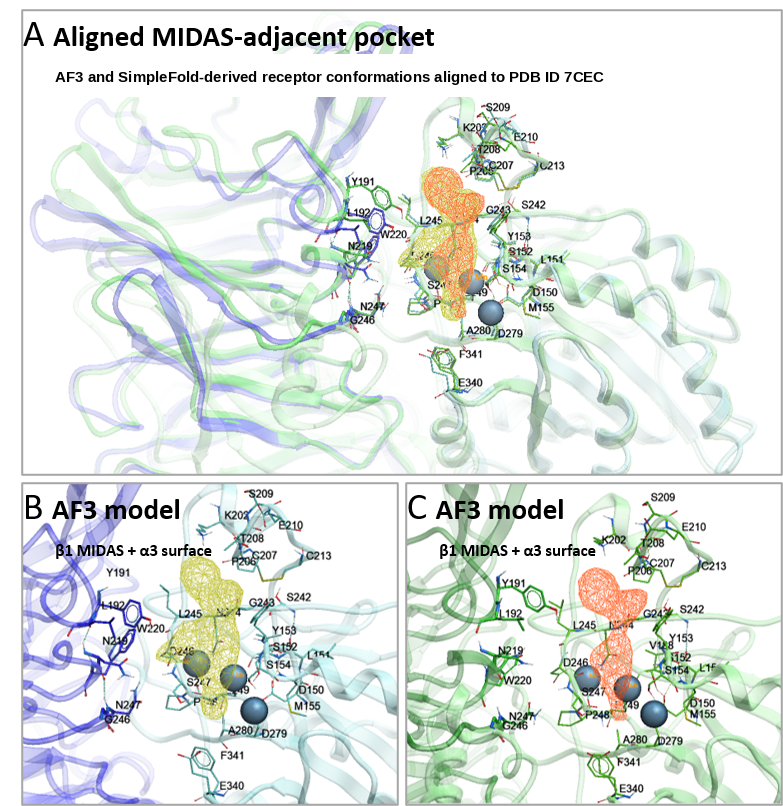
Figure 1. Structural models used for screening. (A) Superposition of AlphaFold 3, SimpleFold-derived, and PDB ID 7CEC-anchored headpiece conformations around the MIDAS-adjacent groove. (B) AlphaFold 3 pocket model spanning the β1 MIDAS and adjacent α3 surface. (C) SimpleFold-derived pocket model spanning the β1 MIDAS and adjacent α3 surface. The α6β1-laminin structure supplies experimental β1 MIDAS/laminin geometry; the α-subunit surface in the screening receptor is modeled as α3. Meshed surfaces delineate putative ligand-binding volumes identified using ICM PocketFinder.
2.3 V-SYNTHES2 hierarchical screening
The screening input was a reaction-defined make-on-demand REAL-space snapshot recorded in the campaign files as approximately 2.3 × 10¹² structures. V-SYNTHES2 first docked an approximately 1.5 × 10⁶-member minimal enumeration library (MEL) that represented available reaction scaffolds and synthons. CapSelect retained high-ranking MEL poses with geometrically productive growth vectors. Selected branches were then enumerated and redocked until complete molecules were generated, yielding approximately 1 × 10⁶ fully enumerated compounds for final docking8–9. The 10,000-30,000 highest-ranked full molecules were transferred to post-processing. Exact reaction subsets, library release identifiers, docking settings, and stage-specific counts should accompany a final submission in the supplementary data.
2.4 Post-processing and candidate selection
Post-processing was applied after molecular docking so that V-SYNTHES2 enumeration remained driven by receptor-ligand score and pose geometry. The campaign removed PAINS and reactive or otherwise undesirable substructures14, then applied predicted developability filters that included general toxicity, hERG blockade liability, Caco-2 permeability, solubility, and physicochemical criteria15–17. These endpoints were computational predictions used for triage and were not interpreted as experimental safety, permeability, or pharmacokinetic measurements.
Surviving compounds were reviewed for plausible occupancy of the intended MIDAS-adjacent groove, absence of major clashes or unsatisfied polar groups, and consistency across the receptor ensemble. Chemical clustering and novelty assessment were then used to avoid selecting near-duplicate analogues. This workflow produced 300 compounds initially selected for synthesis with Enamine: 100 from 2-component and 200 from 3-component REAL subspaces. Feasibility and cost triage excluded candidates requiring costly in-house/custom synthesis, leaving 225 compounds retained for synthesis by Enamine. The exact prediction platform, model versions, numerical cutoffs, fingerprint, clustering method, and full attrition table should be reported with the compound list in Supplementary Table S1.
2.5 Computing environment
V-SYNTHES2 jobs were executed on University of Southern California high-performance computing resources administered by the Center for Advanced Research Computing (CARC). Vsevolod Katritch provided access to the MolSoft ICM-Pro license and associated computational resources during Antonina L. Nazarova's postdoctoral appointment in his group. The project record reports an approximately 48-hour campaign; final reporting should distinguish elapsed wall-clock time from aggregate CPU-hours using CARC scheduler logs.
3. Results
3.1 A MIDAS-adjacent α3β1 receptor ensemble was prepared for docking
Alignment of the AlphaFold 3 heterodimer, SimpleFold-derived conformers, and the PDB ID 7CEC template produced a common extracellular headpiece frame with conserved β1 MIDAS geometry and an adjacent α3 surface suitable for grid construction (Figure 1). The 4D grid sampled discrete pocket conformations while preserving the metal-centered region used to anchor the laminin γ-chain in PDB ID 7CEC. The modeled site was spatially separate from ITGA3 p.Thr658Arg and therefore tested ligand-interface modulation rather than direct correction of that residue.
3.2 Hierarchical enumeration reduced the tera-scale space to a tractable docking set
V-SYNTHES2 compressed the reported 2.3 × 10¹²-compound space to an approximately 1.5 × 10⁶-member MEL, used CapSelect to identify productive branches, and generated approximately 1 × 10⁶ complete molecules for final docking. This retained physics-based receptor-ligand evaluation at each stage while avoiding exhaustive enumeration of the full reaction space. The final docking rank supplied a 10,000-30,000-compound pool for developability triage (Figure 2).
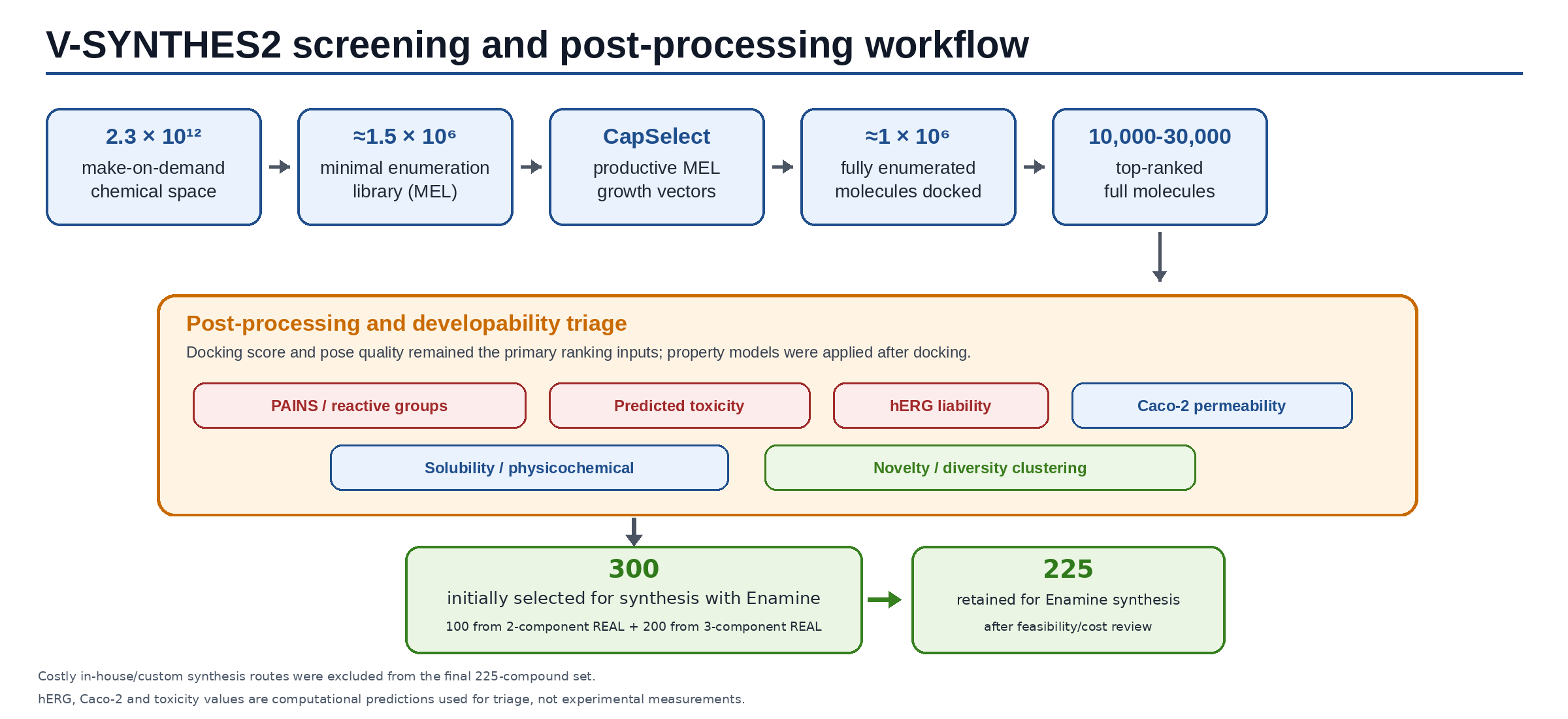
Figure 2. V-SYNTHES2 screening and post-processing workflow. The reaction space was reduced through MEL docking, CapSelect, selective enumeration, and full-molecule docking8–9. Top-ranked molecules were filtered for PAINS/reactive groups, predicted toxicity, hERG liability, Caco-2 permeability, solubility and physicochemical properties, then clustered for novelty and diversity. This yielded 300 compounds initially selected for synthesis with Enamine—100 from 2-component and 200 from 3-component REAL subspaces—of which 225 were retained after feasibility and cost triage14–17. Costly in-house/custom synthesis routes were not advanced.
3.3 Post-processing selected 300 synthesis candidates and retained 225 for Enamine synthesis
Sequential structural-alert, ADME-toxicity, and permeability filters removed candidates with unfavorable predicted profiles before diversity selection. Pose review and clustering reduced the post-docking pool to 300 compounds spanning distinct chemotypes: 100 from 2-component and 200 from 3-component REAL subspaces. These 300 compounds were initially selected for synthesis with Enamine. After excluding candidates requiring costly in-house/custom synthesis, 225 were retained for synthesis by Enamine. Because the complete 300-compound list, 225-compound synthesis list, and filter-by-filter attrition log were not embedded in the presentation, this manuscript does not assign individual structures, scores, or predicted property values. No binding or functional measurements were available at the time of writing.
4. Discussion
The principal result of this study is a V-SYNTHES2 workflow that converted a tera-scale reaction space into 300 compounds initially selected for synthesis with Enamine, 225 of which were retained after feasibility and cost triage. The hierarchical strategy is central to the result: only representative MEL fragments and selectively enumerated branches were docked, allowing receptor-based scoring to guide the search without brute-force evaluation of 2.3 trillion complete molecules. The campaign therefore extends the original V-SYNTHES concept and the automated V-SYNTHES2 implementation to a modeled, shallow, metal-adjacent protein-ligand interface8–9.
The 4D receptor model addressed a major source of uncertainty in this target. No ligand-bound experimental α3β1 structure was available, and local loop and side-chain differences could substantially change a shallow pocket. Combining AlphaFold 3, SimpleFold-derived conformers, and the PDB ID 7CEC structural anchor allowed multiple plausible pocket geometries to contribute to docking. This ensemble is nevertheless a computational approximation: it does not fully represent glycosylation, membrane coupling, metal occupancy, or the complete activation-state landscape of an integrin. Consequently, a high docking rank should be interpreted as a prioritization signal rather than evidence of binding affinity.
Post-processing was designed to prevent the final list from being dominated by compounds that score well but are unsuitable for testing. Structural-alert and predicted developability filters were combined with pose review and diversity clustering14–17, which is especially important when giga-scale libraries place many close analogues near the top of a ranking. These filters improve synthesis-selection decisions but do not establish safety, oral exposure, permeability, or absence of assay interference; those properties require experimental confirmation.
The 225 compounds retained for Enamine synthesis should next be tested in a compact assay cascade: compound identity and solubility, direct or orthogonal α3β1 target engagement, counter-screening against related β1 integrins, and functional testing on laminin-332. Only those experiments can classify a compound as antagonist-like, agonist- or rescue-like, inactive, or off-target. Until then, the products of this campaign are best described as computationally prioritized candidate α3β1 binders.
5. Conclusions
V-SYNTHES2 screening of the modeled α3β1 MIDAS-adjacent pocket produced 300 compounds initially selected for synthesis with Enamine (100 from 2-component and 200 from 3-component REAL subspaces); 225 were retained after feasibility and cost review. The campaign provides a practical route from tera-scale chemical space to experimental candidates; binding, pharmacology, and therapeutic relevance remain to be determined.
Acknowledgments
The authors thank the patient and family whose participation motivated this work and Research to the People for the Lung Fibrosis Patient Hackathon initiative. The authors acknowledge the Center for Advanced Research Computing (CARC) at the University of Southern California for high-performance computing resources. Vsevolod Katritch provided access to the MolSoft ICM-Pro license and additional computational resources used to run V-SYNTHES2 during Antonina L. Nazarova's postdoctoral appointment in The Katritch group at USC. Pete Kane and Hanan Sinada provided the omics data that informed target selection.
Funding
This work was supported by a Lung Fibrosis Patient Hackathon grant from Research to the People. Computational resources were provided in part by USC CARC, with all the software and laboratory resources provided through the Katritch group.
Author Contributions
Antonina L. Nazarova: conceptualization, methodology, software, investigation, formal analysis, visualization, project administration, and writing - original draft and revision.
Data and Code Availability
The V-SYNTHES2 workflow and code are described in reference 9. A publication-ready campaign include the receptor models and 4D grid, exact chemical-space release and reaction definitions, screening configurations and logs, and the complete 300-compound initial synthesis selection and 225-compound retained Enamine synthesis list, including structures, identifiers, docking results, and predicted properties and available upon request.
Competing Interests
The authors declare no competing interests.
Be the first to comment on this publication.